
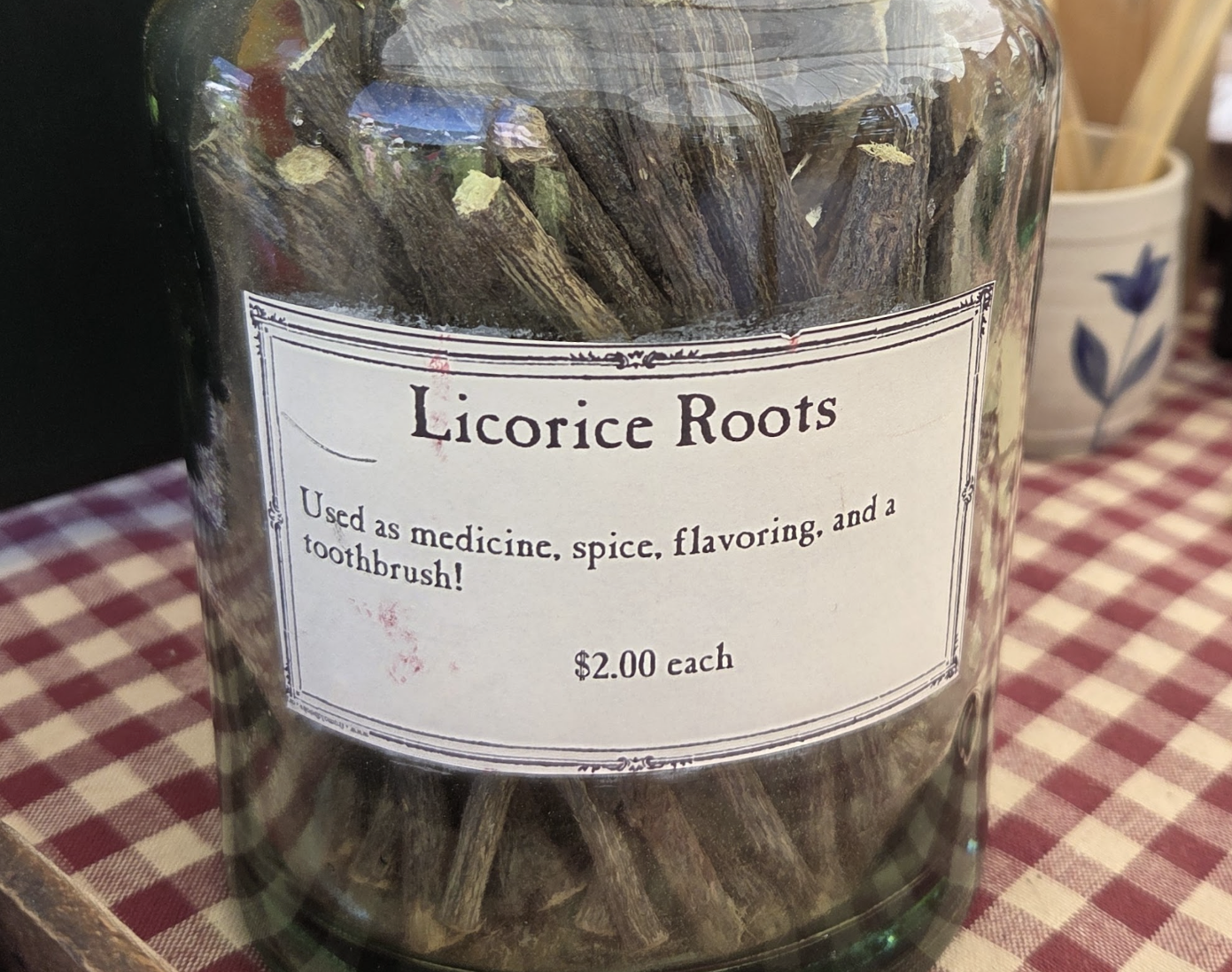
A jar of licorice root at the Appalachian Festival in New Richmond, Ohio, photographed on May 10, 2026. Licorice root is still widely used today by Native and Appalachian cultures to flavor food and to heal many ailments including cough, fever, earaches, and toothaches. (Image credit: Anna Barnes)
By Anna Barnes
To study past and present cultures in the Appalachian region is to develop a deeper understanding of America’s history. According to the Appalachian Regional Commission, there are three federally recognized Native tribes that currently reside in Appalachia: the Seneca Nation of Indians of New York, the Eastern Band of Cherokee Indians of North Carolina, and the Mississippi Band of Choctaw Indians. Due to forced removal during the 1830s and 40s, there are no federally recognized tribes in the overwhelming majority of Appalachia. Before the arrival of European settlers, a large number of Native groups called this region home, including numerous Algonquian, Iroquoian, and Siouan Tribal Nations. Appalachia is currently an amalgamation of Native, Black, and European roots, blending its inhabitants’ stories and traditions into something unique and multi-faceted.
To begin learning how Native culture influenced European settlers, I attended the Appalachian Festival in New Richmond, Ohio, earlier this year. Next, I met with Tyler Swinney, the Native American Graves Protection and Repatriation Act (NAGPRA) Manager and Tribal Liaison at the Geier Collections and Research Center in Cincinnati, Ohio. With the help of Swinney, I studied and photographed Native artifacts that had been found in Appalachia. I then read Darla Spencer’s Early Native Americans in West Virginia: The Fort Ancient Culture to establish connections between objects I encountered at the Appalachian Festival and the collection of Native artifacts at the Geier Center.
Pre-Colonial Communities: History & Artifacts
When studying the connections between Native and Appalachian cultures, the Late Precontact and Protohistoric periods (circa AD 1000 to AD 1700), are of major focus. The Late Precontact period took place before European contact and the Protohistoric period happened during European contact. During this time, Native tribes became more sedentary than they were previously, residing in places for longer and migrating less. Large villages, surrounded by palisade walls, were often made up of rectangular houses constructed in a circular format around an open central plaza. These villages were often established near rivers and streams. The central plaza concept being commonplace demonstrates the importance of shared resources and community gatherings in which every individual Native person played an important role. According to David Sibray’s 2026 article, Ancient spirit ‘underwater panther’ carved in stone survives in West Virginia, not only is water important for sustaining life, but Native cultures also frequently showed gratitude towards the power of water. In the book Early Native Americans in West Virginia: The Fort Ancient Culture, Darla Spencer describes the artifacts that are commonly found in these villages, including discoidals, bone tools, stone tools, pottery, spears, and arrowheads, along with other features including burial sites, hearths, storage, and refuse pits.
Discoidals
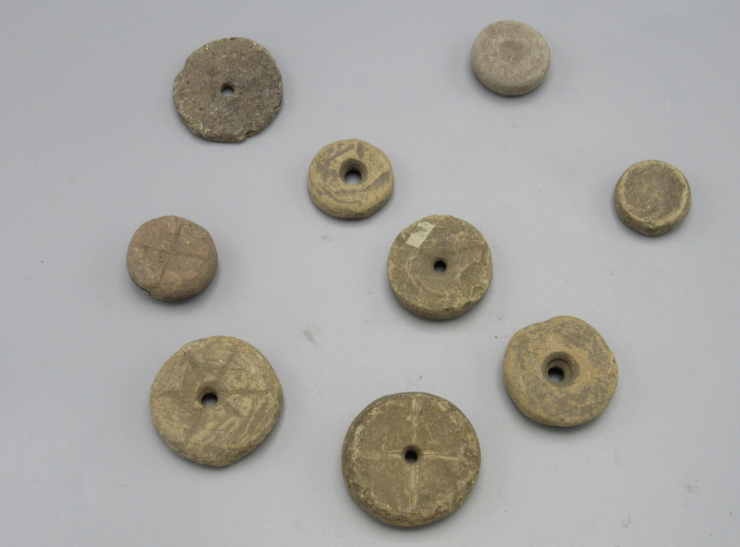
The exact purpose of these circular, weighted objects called discoidals is unknown. Some archaeologists have hypothesized that smaller discoidals could be weights for making fabrics and cordage or counterweights for pump drills, while larger discoidals were possibly game pieces for the Native game “Chunkey,” which is similar to bocce ball.
Bone Artifacts
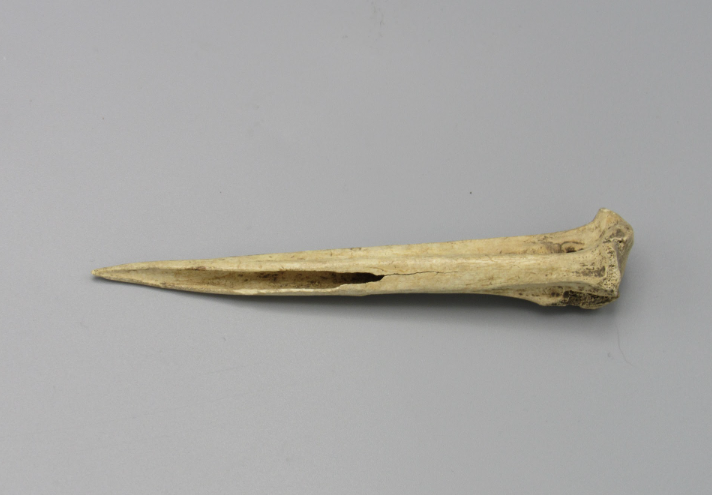
Native tribes relied heavily on bones for tools, art, and dress. Bone awls like the one pictured above were commonly used as perforators or needles for making clothing or tattoos. Drilled bone beads and ornaments were used to decorate clothing during important community gatherings.
Lithic
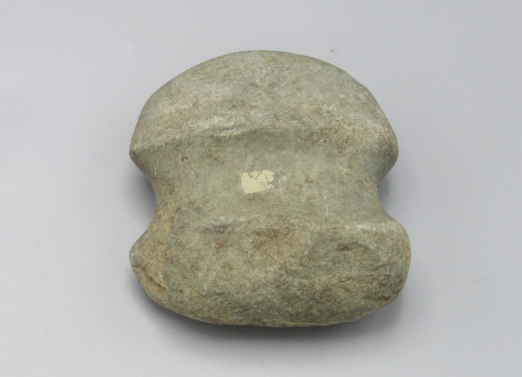
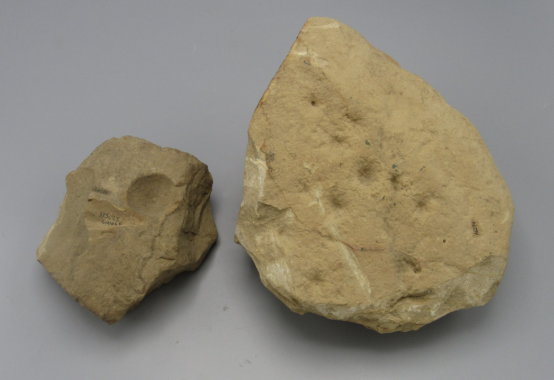
Stone tools, known as lithic, were often made out of chert (flint). Axes and hammerstones were usually made from igneous and metamorphic stones. Native life relied on a wide variety of stone tools including knives, hoes, scrapers, axes, and hammerstones to perform daily functions like hunting, preparing food, chopping wood, cracking nuts, and for agriculture.
Pottery & Salt Pans
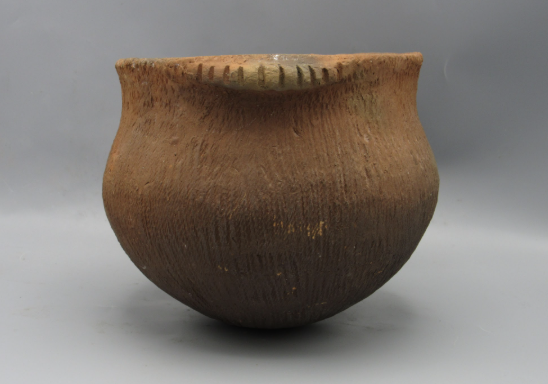
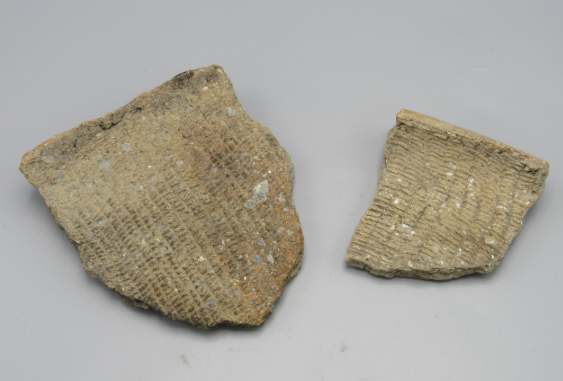
Pottery was typically made by women and played major roles in cooking, storing, and transporting food and other objects. Pots often had lug or strap handles and were tempered with fresh water mussel shells to prevent cracking during the drying and firing processes.
Salt pans were large, often exterior-textured dishes that allowed for salt harvesting by holding water that slowly evaporated to leave behind the salt in the dish.
Spears & Arrowheads
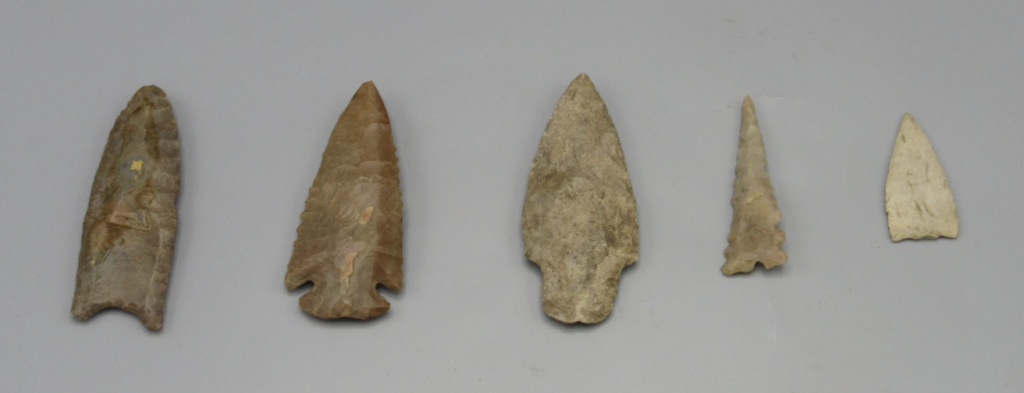
Spears, knives, and arrowheads served important roles in hunting and conflict. They are durable symbols of the Tribal Nations that colonized the Americas many thousands of years before European arrival.
Native & Appalachian Stories
Many Native and African legends became foundations for Appalachian folklore. It is said that Natives were the first to report sightings of Bigfoot, a tall and furry half-man half-ape who wanders through the forest. Wampus Cat, also known as the Cherokee Death Cat, a half-dog half-cat that runs around in the dark on its hind legs or on all fours, is believed by Native and Appalachian people to be evil. It is said to have glowing eyes, driving people it encounters to insanity. There are still frequent claimed sightings of paranormal activity throughout Appalachia today.
How Native Legacy Has Shaped Appalachia
Native culture strongly influenced Europeans as they began settling in Appalachia in the 1700s and these impacts are still present today. Many roads and highways that currently exist in Appalachia are the same routes that Native tribes used for travel and trade. Rivers and mountains in the region have Native names. The Qualla Boundary is a plot of land in North Carolina that is privately owned by the Eastern Band of Cherokee Indians, who were able to hold their ground after the arrival of European settlers. And according to Larry Jent of the West Virginia Highlands Conservancy, “More than 60 percent of the world’s table fare was introduced by Native American farmers,” including corn, freeze dried potatoes, “cranberries, pineapples, cocoa, peanuts, wild rice, avocados, papayas, pecans, strawberries, blueberries,” and more.
There are many other ties between Native and Appalachian cultures: strong connections between people and land, handmade tools and household items, art – especially in the form of paintings and music, food preparation and preservation methods, agricultural practices, and traditions and stories passed down through generations of families. According to Maya Jarrell’s 2022 article, In the Mountains: Cherokee Culture has Rich History and Strong Influence in Southern Appalachia, “Art practices such as basketry, pottery, and wood carving that are often thought of as synonymous with Appalachian culture are originally Cherokee practices.” And though both Native and Appalachian cultures historically spent much of their time performing duties for their survival, there was always time found for leisure, especially for games, music, and storytelling.
When appreciating Appalachian culture, we must recognize all Native, Black, and European customs that have played major roles in its formation.
References
agchast2. (2023, August 20). Legends and folklore: Uncovering Appalachian myths and mysteries. The Wandering Appalachian. https://www.thewanderingappalachian.com/post/legends-and-folklore-uncovering-appalachian-myths-and-mysteries
Appalachian Regional Commission. (2026, October 3). Tribal communities in the Appalachian region. Tribal Communities in the Appalachian Region
Jarrell, M. (2022, November 21). In the mountains: Cherokee culture has rich history and strong influence inSouthern Appalachia. Lees McRae. https://www.lmc.edu/about/news-center/articles/2022/feature-article4.htm
Jent, L. (2024, July 9). Exploring Native American influences in Appalachian traditions and cuisine. West Virginia Highlands Conservancy. https://www.wvhighlands.org/article/exploring-native-american-influences-in-appalachian-traditions-and-cuisine/
Sibray, D. (2026, August 31). Ancient spirit ‘underwater panther’ carved in stone survives in West Virginia.
West Virginia Explorer News. https://wvexplorer.com/underwater-panther-west-virginia/
Spencer, D. (2016). Early Native Americans in West Virginia: The Fort Ancient culture. The History Press.