
By Hilary Hirtle
Out this September and available for presale, Black Appalachia: Race, Place, and Identity, forthcoming from The University Press of Kentucky, features more than twenty-five emerging and established scholars and creatives who explore, celebrate, and shed light on the Black experience in Appalachia.
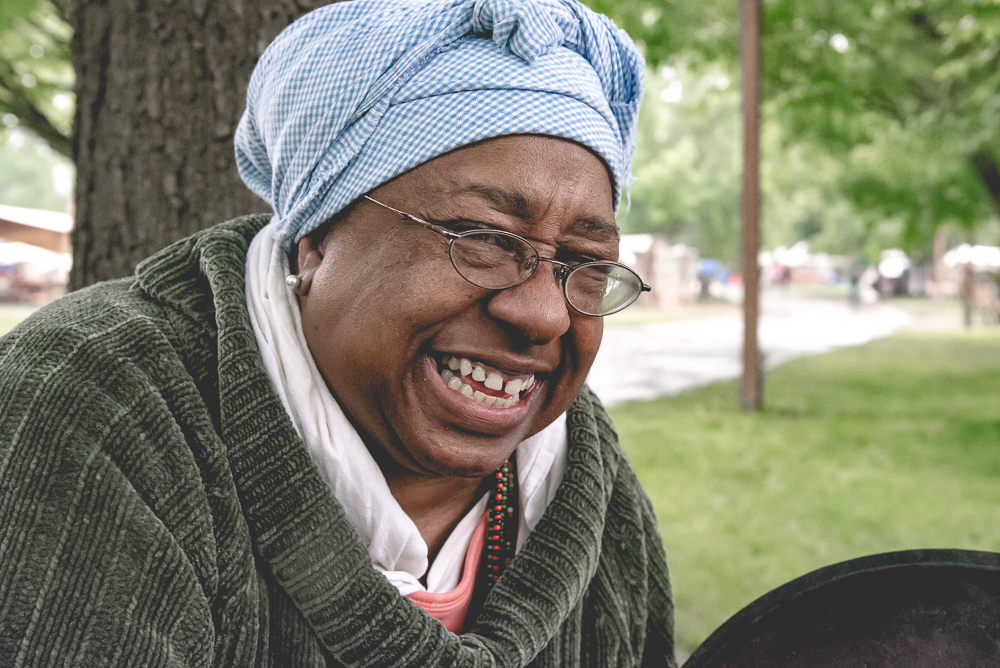
Recently, I had the pleasure of sitting down and speaking with Omope Carter-Daboiku, whose creative work is included in this upcoming book. I always love the chance to speak to another writer. There’s so much to learn from their own story, the pieces they write, and the creative wisdom they share. Speaking with Omope did not disappoint. Omope is a born storyteller with an encyclopedic knowledge of her family’s history, an abounding love for Appalachia, and a deep attachment to her hometown, Ironton, in southern Ohio.
As we got started, I had so many questions. One of which was asking Omope when she knew she wanted to write and to create and share stories. “When I was nine years old,” she replied.
She was known for her storytelling gift in Sunday school and was an avid reader. As a child, the library was the only place Omope’s mother would let her go where she couldn’t watch her. For Omope, the gift of that independence and time alone among the books became her sanctuary. “I read everything in the juvenile section up to the point that the librarians were pointing me to the new arrivals.” But the books she read, such as The Hardy Boys or Nancy Drew, were books that didn’t reflect her experience as a young Black girl growing up in Appalachia in the 1950s and 1960s. “Deep down somewhere in myself I thought ‘when I grow up I’m going to write about stuff that people like me know.’”
In Black Appalachia, Omope’s poetry and prose include works such as Them Black Patent Leather Shoes, Lessons From the Edge of Appalachia, and Black Joy. Each piece explores the very themes in which her work is known—race, place, and identity. When I asked her what she thought about being included in Black Appalachia, she gave a deep belly laugh. “I get to be in that number? I get to sit at the big kids’ table? I think I’m just overwhelmed by it. There’s been so many things in my life that have been overwhelming. They’re like these waves that set me off in an entirely new direction or that push me further out to sea or they just give me a whole different landscape to look at.”
It was these “waves” in Omope’s journey that stood out to me the most when speaking with her. Her journey to becoming a storyteller and to being featured in Black Appalachia is an incredible story of self-discovery based on connecting to her Appalachian identity and heritage. Growing up in Appalachia, and then moving to Columbus and then Cincinnati, Ohio for college would become the catalyst for recognizing her own unique experience of growing up as a Black Appalachian and how much her home region shaped who she was.
Omope told me of a point when, as a student at the University of Cincinnati, she was feeling homesick for Ironton and on a whim after someone had mentioned it to her, she decided to go to the first Appalachian Festival held by the Appalachian Community Development Association. It was there that she came across the Urban Appalachian Community Coalition (UACC) booth which had a big map and the invitation for festival participants to put a sticky note on their “home place” in the Appalachian region. She proudly placed her sticky note right onto Ironton and someone said “You are from Appalachia.” As she explained to me, that moment marked the beginning of a turning point that would define her connection to herself as an Appalachian African-American woman and her creative work as a storyteller. “I didn’t need to go to Cincinnati to find culture. It was in Cincinnati that I realized that I had culture. All I had to do was embrace it.”
Years after that day at the festival, living in the city, having recently gone through a divorce and facing the challenge of raising children on her own, Omope asked herself, “How am I going to raise these kids by myself with the same values that I had growing up?” And she remembered that moment at the UACC booth all those years ago. It was the beginning of another wave on her journey.
Omope became a volunteer with the UACC, eventually serving on the cultural advisory committee, helping to bring cultural events that celebrated Appalachian heritage and raised awareness of the Appalachian diaspora in Cincinnati. These have included the annual Appalachian Festival held over Mother’s Day weekend; the annual Ringin’ in An Appalachian New Year held over the Dr. Martin Luther King weekend; the Perceptions of Home: The Urban Appalachian Spirit digital exhibit; and the Kith and Kin Story Gathering Project, to name just a few.
With the UACC, Omope also co-led writing workshops to help participants craft the personal narrative section for their GED tests. This led to invitations from the University of Cincinnati to do a talk on Appalachian storytelling and being a Black Appalachian. It was the beginning of another wave leading her on in her journey as a storyteller.
“The people at UACC are my extended family,” Omope reflected. “They helped me raise my kids and myself.”
Omope’s work has not only contributed heavily to raising awareness on the presence of Appalachian culture, but also to the Black Appalachian experience, something which has often been erased. When I asked Omope what she wished all readers knew about Black Appalachians she said simply, “That we exist.” She went on to elaborate: “Unfortunately, I think many Americans who don’t travel outside of their hometown or region, don’t know much about the country outside of where they live. I just wish people knew more about American history, period. The depth of American history.”
As our interview wound down, I couldn’t help but wonder where another wave will take Omope next. At the moment, Omope said she is on a quest to “Get all this stuff in me out. Those of us who are now elders, who have all of this knowledge to share, we have to spend the next several years getting it out.”
I look forward to learning more wisdom and hearing many more stories from Omope Carter-Daboiku.
Black Appalachia: Race, Place, and Identity will be published in September 2026 by The University Press of Kentucky.