
By Mike Templeton
As many readers know, the Urban Appalachian Community Coalition has a special relationship with the long-standing urban Appalachian neighborhood of Lower Price Hill. This is where our offices are located and where you will find our Frank Foster Library, but our history in this great neighborhood goes back decades. In many ways, Lower Price Hill serves as something of a barometer of the health of our urban Appalachian communities since the neighborhood tends to be both vulnerable and resilient. If the folks in Lower Price Hill are doing well, it is likely that other neighborhoods are also getting by. Taking a moment to check in with Lower Price Hill also offers a window into how greater Cincinnati is evolving with respect to urban Appalachian communities and the neighborhoods we share with all the other communities that make up our ever-evolving city.
Lower Price Hill is not only an historically urban Appalachian neighborhood, but it remains so even as many other communities have moved in and redefined the demographics. As a lower-income neighborhood, Lower Price Hill often stood defenseless against corporate actors who sought to get around environmental regulations with the idea that no one would notice. Consequently, things like the Queen City Barrel fire constituted another instance of environmental discrimination against poor communities. The fire left behind toxic soil contamination and complicated already existed poor air quality problems that have been the source of health problems in Lower Price Hill for decades. Since the fire, much as been done to try to lessen the damage, and this has, to a large extent, transformed Lower Price Hill into something of a model for what some have called a climate safe neighborhood.
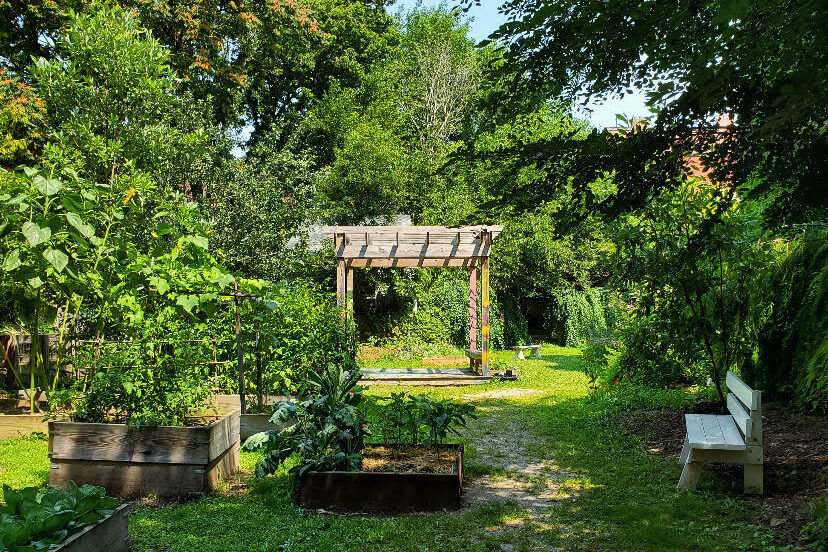
A number of efforts and organizations have come together over the past two and a half decades to map out multiple plans for rejuvenating Lower Price Hill and set it on a course for the 21st Century. Some of this has been centered on Oyler School which we have reported on in a number of contexts, not least of which has been the outstanding achievements of Oyler School Students. Other things include a partnership between the City of Cincinnati, Lower Price Hill community leaders, and a non-profit organization called Groundwork Ohio River Valley. This has led to a push to transform Lower Price Hill into Ohio’s first climate ready neighborhood. By forming a plan built out of strategic initiatives and community concerns, Groundwork Ohio River Valley has been creating climate efficiency measures throughout the neighborhood. These measures include the creation of a tree canopy within the neighborhood designed to lock in the natural cycles of climate efficiency that come with the re-establishment of the natural foliage of southern Ohio. Other measures have included things like misting and cooling centers at area bus stops and heat absorbing asphalt in strategic points around the urban area. Still more measures will include increasing the number of urban greenspaces. Lower Price Hill already has two community gardens and urban greenspaces. By building on these kinds of efforts, the neighborhood hopes to expand greenspaces into urban gardens, and the long-term goal is to link these gardens and even urban farms to the present work at Meiser’s Fresh Grocery and Deli, and Meiser’s is something else we have reported on at length.
Much of the work in LPH has come about under the larger civic umbrella of the Lower Price Hill Resurgency Plan, a long-range plan created in partnership with the City of Cincinnati and Lower Price Hill community leaders designed to lead to a kind of re-birth of the neighborhood after the nightmare of the Queen City Barrel fire. Even as the remnants of the toxicity of the fire still pose a threat, the city and other partners are working to include clean-up measures with a larger effort that goes beyond returning things to a status quo. Of course, Meiser’s was part of this plan, and future plans include things like affordable housing efforts that will make it possible for Lower Price Hill residents to benefit from rejuvenation efforts without getting entirely caught up in the kinds of gentrification we have seen in other parts of the city. Some of the work of the LPRP have already taken hold with demonstrable success. We look forward to what may come with some of the other ambitions and goals of this plan.
As a benchmark for how to understand the ways the various Cincinnati neighborhoods are situated, the primary text is still The Social Areas of Cincinnati by UACC founder Michael Maloney and Christopher Auffrey. It is in this that we can see how the demographics, economics, and social arrangements of an historically urban Appalachian neighborhood such as Lower Price Hill is currently faring. We checked in with people in the neighborhood back in 2021, but much has happened since then. Seeing the Queen City Barrel Fire as a kind of crisis point for the neighborhood helps us to put in perspective both the changes in the neighborhood, for good or ill, and the strategic plans and efforts that are underway toward sustaining this historic neighborhood for the future. As a signature urban Appalachian neighborhood for the Urban Appalachian Community Coalition, it is genuinely refreshing to know that neighborhood leaders, the city, and community partners are in line with us in insisting that Lower Price Hill not only remain but continue to be a cornerstone of Cincinnati urban life.
Michael Templeton is a writer, and independent scholar. He is the author of The Chief of Birds: A Memoir published with Erratum Press and Impossible to Believe, published by Iff Books. He is also the author of Collected Apoems, forthcoming from LJMcD Communications, The Ohiomachine, forthcoming from Dead Letter Office/Punctum Books, and Nod: On Digital Exile forthcoming with Erratum Press, the Academic Division. Check out his profile in UACC’s Cultural Directory. He has published numerous articles and essays on contemporary culture and works of creative non-fiction as well as experimental works and poetry. He lives in West Milton, Ohio with his wife who is an artist.
Dear Mr. Templeton, DEAR ALL: Blessings! For 10 years, from 2008-2018, I was the Pastor of State Avenue United Methodist Church in Lower Price Hill. In my heart, and in my husband’s heart, Lower Price Hill will ALWAYS HAVE A SPECIAL PLACE. We keep special Memories of our Ministry there, walking the streets, sharing life experiences, Worship, Baptisms, Funerals, weddings, Community Fairs, Christmas events, Community dinners, Appalachian Fest, and fellowship with devoted and passionate leaders and neighbors, The Church was a place for gathering, and sharing Faith and Life together for all in the Community. As I revisit my life and Calling, I am so grateful to God, who allowed us to serve Lower Price Hill. PLEASE, convey my Blessings to the Community, ALWAYS IN OUR HEARTS;, and feel free to contact us . I Christ’s love, Peace. Rev. Dr. Nilsa P. Saliceti 787-617-4796
Could you provide the addresses of the community gardens currently in LPH? The photo you posted is lovely. Where is that greenspace? I’m sad that a building was erected on the site of the Aaron Raines Memorial Garden which was along the west side of the former main office of UAC.
I believe that picture is one of the gardens that Community Matters operates. The author makes no mention of the organization here, but their good work has had quite the impact in Lower Price Hill. The Frank Foster Library is actually located within one of their spaces.