By Michael Templeton
Editor’s Note: It is all the more poignant that our intrepid blogger Mike Templeton has ended his weekly series for UACC as he began some six years ago with an article about our beloved Gurney Norman. Many thanks to Mike for all he has given our readers during these years. You can continue to follow his work at templetondidelphis.wordpress.com. We wish him the best in all he does! –Pauletta Hansel
As many folks already know, the great Appalachian writer and advocate Gurney Norman died on October 12 of this year. He was 88 years-old and passed peacefully. Norman leaves behind a legacy that simply cannot properly be recounted in a single article, tribute, or obituary. There will likely be an entire industry of books and studies about Gurney Norman for decades to come. The first article I ever wrote for the Urban Appalachian Community Coalition was about a reading by Norman and our own Pauletta Hansel who named Norman as her mentor. As I end my time writing regularly for UACC, I find myself writing about Gurney Norman once again. Norman’s travels were far and wide over his life, but he did touch down in greater Cincinnati at one point, and he wrote about visiting his brother in Northern Kentucky who had come north for work, a story that forms part of the backbone of urban Appalachian identity and experiences and situates Gurney Norman and his work within the urban Appalachian world.
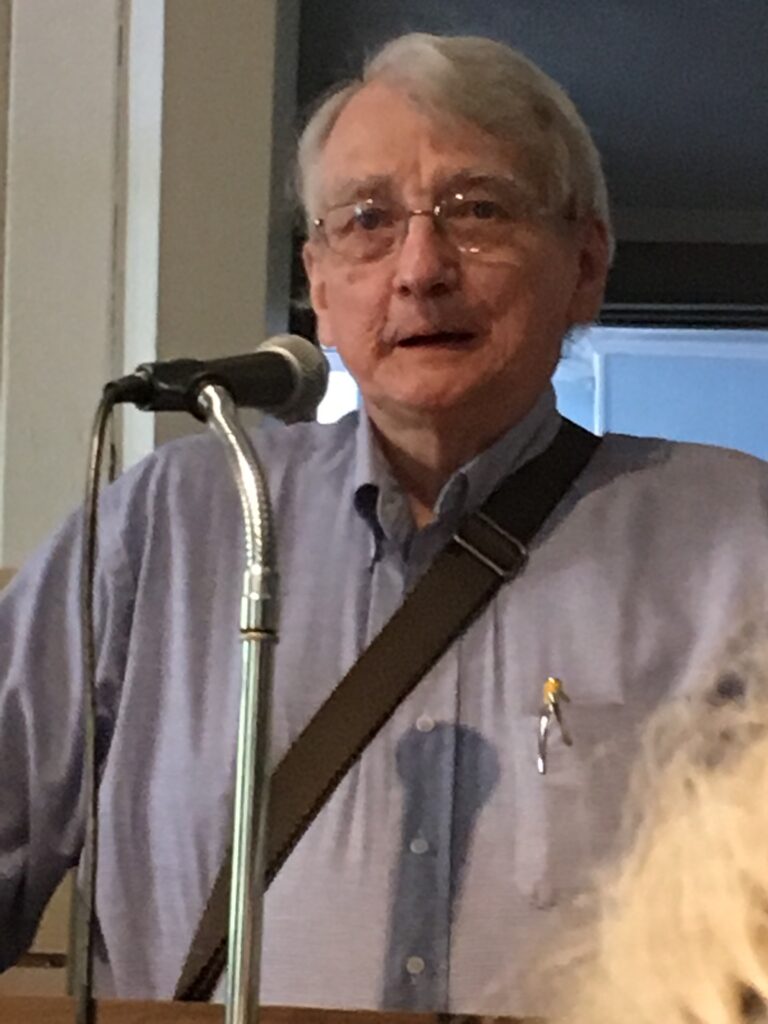
Gurney Norman was a professor of fiction at the University of Kentucky since 1979. He was a novelist, essayist, writer of short stories, writer for film—I could fill this article up with a list of the works by Gurney Norman. What we now call Appalachian literature was in some measure shaped by Gurney Norman, beginning with his first and only novel, Divine Right’s Trip, published in 1972 and originally serialized in The Whole Earth Catalogue. His work with the Southern Appalachian Writers Cooperative laid the groundwork for a literary space that is still growing today. In a 1990 interview with Chris Green, Gurney Norman recounts the beginnings of the Southern Appalachian Writers Cooperative. Norman explains the conditions for Appalachian writers at the time, around 1974-75, and the struggles people faced professional, personally, and economically in a region that had no resources for writers to pursue their craft. In a series of meetings at the Highlander Center in Tennessee, and elsewhere in the region, SAWC emerged as a project, a book idea, and at least two periodical publications. Founded by Norman, SAWC encompassed a host of people who would come to define Appalachian literature and writing— the great Bob Snyder for example, and the wild bunch known as the Soup Bean Poets. It is worth noting that former Soup Bean Poet and current SAWC member Pauletta Hansel is offering a story circle at the March 2026 Appalachian Studies Conference to give space to those who wish to remember him in this way.
For a great many of us, and I am proud to include myself as a small contributor, SAWC remains a force in Appalachian literary culture. I include the link for this interview below, but Gurney Norman makes one ostensibly small observation that I believe stands out as a beacon of Appalachian literature and life and as a hallmark of his legacy. In explaining how things came together, Norman tells us that there was no set agenda for people, no set of fixed goals, and certainly no directives. The way SAWC coalesced into a living entity had to do with a philosophical approach that was different than the academic model. Norman explains, “The point is to empower and encourage other people to build community, to build itself. And it’s in the doing of it that you build strength.” If there is anything that has stood out over the course of nearly eight years of writing about Appalachian life and culture it is the process of finding strength in the doing of it. The way people left the southern mountains, found a home in far off places like Cincinnati, and found the strength to lift others up over the hurdles they had leaped was found in the doing of it.
These kinds of insights are a constant in all of Norman’s work. The reason his voice stood out as being so stellar was precisely the way a small turn of phrase, a seemingly incidental observation, or even a quotidian topic like a high school football game could re-orient the way the reader understands everything—and I mean everything, including the world around us. People read Norman’s Wilgus stories, (in Kinfolks, 1977, and Allegiance: Stories, 2020) and their view of life was forever changed. These otherwise “down-home” stories of young man from the hills carried more weight than anyone thought was coming. George Brosi, writing of Norman’s career, observed that “Norman’s writing is true to the traditional lives and language of mountain people. At the same time, his work is anchored in a solid vision that is informed by a truly international consciousness.”
That knack for transforming the quotidian into the universal is perhaps a function of this thread that runs from the lives and language of mountain people to the international perspective Norman gained quickly and voraciously in his time traveling, studying, and working in other parts of the country. Yet, some of what emerged has to be attributed to a talent that was genuinely singular. It was Gurney Norman’s unique way of observing and composing around observations that created literary moments in ways no one else could.
Since his passing a great many tributes and obituaries have been published that testify to the outsized influence of Gurney Norman. It is impossible to talk about Appalachian literature without identifying the ties to Norman in some emphatic way. I will single out the obituary in Kentucky Lantern as one that is extremely detailed in the salient features of Norman’s life and career. Written by Jamie Lucke, this tribute mentions, among many other things, the 2023 Gurneyfest that was held in 2023 that including a screening of a film trilogy based on the Wilgus stories and starring Ned Beatty. Lucke also mentions how Norman’s early life was marked by so much tragic loss, experiences which found their way into his written work over the course of his entire career. There was a heroic aspect to those who shaped Norman’s life that Lucke seems to foreground, and which Norman wrote of in his descriptions of the strength he saw in his mother, something that appears to emerge in the description of Opal in the story “15 Dollars” in which Norman wrote, “She wasn’t big as a minute, but she could work from daylight till dark and never slow down. And it was real work, too.”
It is only right that the majority of the attention that is devoted to Norman’s work and career is in terms of his importance and influence on Appalachian culture and literature, but it seems important to mention that Norman was a countercultural influence as well. Coming of age in the 1960s, and finding traction for his ideas and his work amid the storm that was Highlander Center in the 1970s, Norman did not shy away from taking a radical stance toward the world around him. There was a kernel of the militant coal miner to Gurney Norman that should not be diminished. Although this radical political orientation may not have been manifested in ways that appeared countercultural in the ways some have come to imagine. Being outsiders almost by definition, Appalachian writers were radical in the sense that they fought for their right to speak against a literary and academic mainstream that would have written them off out of hand.
When I took on the role of the blog writer for the Urban Appalachian Community Coalition, I had no idea what I was in for. To have been entrusted as a voice of urban Appalachia for the past six years will forever stand out as one of the greatest honors of my life. I can only hope that I rose to the task in a way that honors all the people who built what we now call urban Appalachian culture in all its forms. I know I will sign off from this post with a satisfaction few people get to experience in life. I am grateful to everyone associated with the Urban Appalachian Community Coalition, and my work here has grown “in the doing of it.” Gurney Norman never tired of paying tribute to his homeplace and his people. He loved the people, the land, the mountains, the history—Appalachia in all its glory and splendor, and he commemorated it like no one else. I cited his poem, “Allegiance,” when I first wrote about him. It seems fitting to return to this. You can watch a recording of Norman reading “Allegiance” on an event for KET. I think I would like to give Gurney Norman the last word in this with a short quotation from “Allegiance.” (Editor’s Note: We apologize for any errors and for lack of line breaks; Mike only had access to an audio version, and I have just moved so all my books are packed. P.H.) It seems to sum up his life’s work in many ways as much as it sends us off with the work left to be done:
“I honor those in the mountain region who have chronicled the history, made us know what happened, the good and the bad, and all praise to those who across the generations have made the poetry and the music and remembered the old stories and told them in human voices. All praise to the young people who have listened and will tell the tales again and add their own; and the senior people, the old ones with us still and those gone on. I see them in my mind, carry them in my heart, and thank them all and will sing their names as a song in pledge of my allegiance.”
The University of Kentucky maintains a memorial page for Gurney Norman at this link focusing on the memorial program hosted by his wife and colleague Nyoka Hawkins: english.as.uky.edu/gurney-norman-memorial.
Chris Green’s 1990 Interview can be read at this link: scholarworks.moreheadstate.edu/sawc_interviews/10.
Jamie Lucke’s obituary from The Kentucky Lantern can be found at this link: kentuckylantern.com/2025/10/14/kind-and-generous-gurney-norman-kentucky-writer-and-teacher-dies-at-88.
Michael Templeton is a writer, and independent scholar. He is the author of The Chief of Birds: A Memoir published with Erratum Press and Impossible to Believe, published by Iff Books. He is also the author of Collected Apoems, forthcoming from LJMcD Communications, The Ohiomachine, forthcoming from Dead Letter Office/Punctum Books, and Nod: On Digital Exile forthcoming with Erratum Press, the Academic Division. Check out his profile in UACC’s Cultural Directory. He has published numerous articles and essays on contemporary culture and works of creative non-fiction as well as experimental works and poetry. He lives in West Milton, Ohio with his wife who is an artist.